
Sacred amulets
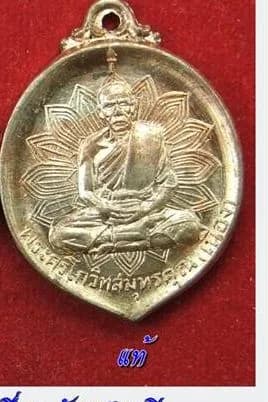
Past editionEcclesiastical-Rank Promotion Medal (Ceremonial Rank-Fan), Luang Pho Nueang, Wat Chulamanee, B.E. 2517 (1974)
B.E. 2517
The ecclesiastical-rank promotion medal (ceremonial rank-fan, phat yot) of Luang Pho Nueang Kowitho, B.E. 2517 — produced from a full ta-kai and a flattened ta-kai die, together with the legend of the miracle of the yantra plate and the points for telling a genuine medal from a fake.
The ecclesiastical-rank promotion medal — commonly called the "ceremonial rank-fan medal" (phat yot medal) — of Luang Pho Nueang Kowitho of Wat Chulamanee was produced in the Buddhist year B.E. 2517 (1974) to mark the occasion of the ecclesiastical rank he had been granted. It was conceived and offered to him by Mayor Bunkoet, the municipal mayor of Amphawa district at that time, who was the owner of the Sawan Osot shop in Amphawa market.
The Full Ta-Kai Die and the Flattened Ta-Kai Die
This edition was made from 2 dies, and the total number produced cannot be stated with certainty.
The full ta-kai die — this was the first batch to be stamped, so the "ta kai" bead-dot pattern on the reverse is still clearly raised and the die remained crisp and complete. Luang Pho Nueang gave these away and offered them for veneration until they were nearly all gone.
The flattened ta-kai die — when too few remained, Luang Pho Nueang ordered the temple committee to have more stamped. But because this later batch of metal was hard, the die began to wear: the lettering on the reverse started to lean over and the ta-kai dots no longer stood out as beads. Stamping continued until the consecrated alloy ran out, yielding no more than around 3,000 medals.
The Legend of the Miracle of the Yantra Plate
It is told from generation to generation that, when casting the consecrated alloy for this edition, Luang Pho Nueang handed the foundry owner a copper plate inscribed by hand with sacred letters, along with the alloy, to be melted down — yet the yantra plate refused to melt. The foundry owner had to return to him once more, and Luang Pho Nueang then inscribed and gave him an additional yantra plate. This time both yantra plates melted with ease.
This very thing happened again at the casting of the second die. When Luang Pho Nueang's yantra plate would not melt and his copper plates had just run out, he had them use instead a copper plate on which Luang Pho Itthi (at that time still a junior monk of the temple) had secretly inscribed sacred letters. After studying it for a moment he pronounced, "This will do," and that copper plate melted with the greatest ease — a marvel that has been recounted ever since.
Examining the Phat Yot Medal (How to Spot a Fake)
Fakes of this phat yot medal have appeared (the earliest sightings were around the start of the year). Fortunately, the fakes of this edition are not too hard to tell apart: anyone who has seen and handled a genuine one can notice the differences, though for those who have never seen a genuine piece it may be a little harder. They are therefore presented here side by side for comparison.
All three medals in the photographs were kindly made available by Luang Pho Itthi of Wat Chulamanee, who permitted them to be photographed and published as a gift of knowledge for students of these objects, so that no one is deceived when acquiring one for veneration (in the photographs, arranged in the order genuine – fake – genuine). The points that help distinguish a genuine medal from a fake are as follows:
The face — the face of Luang Pho Nueang on a fake medal is more swollen than normal (without a genuine one to compare against, it is a little hard to judge).
The medal's lug-loop (suspension ear) — on a fake, the first layer of the kanok flame motif is missing, which makes the lug-loop look narrower.
The die-crack line on the reverse — on a fake the line is too thick (the result of a deliberately added line) and runs long from the left edge downward; on a genuine medal the line ends at the Thai letter ก, whereas on a fake it ends at the Thai vowel า.
The line from the ta-kai — on a fake it is a thick line; on a genuine medal it is only a small fine crack.
The thickness — a fake is thinner than a genuine medal.
A word of caution
These observations are offered for educational purposes only. Please always exercise your own careful judgement when examining any sacred object.
Note: This content has been compiled from articles recording the history of Wat Chulamanee (compiled by Ko Maeklong, with permission from Luang Pho Itthi to publish), in order to record the history of this edition of the medal. It is in no way intended for any purpose of buying or selling.