
Sacred amulets
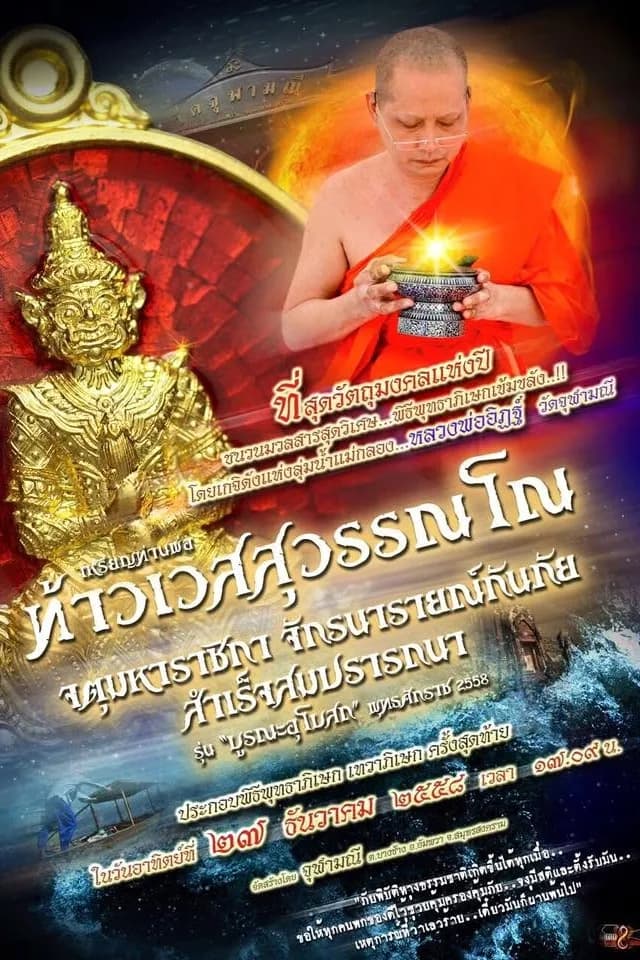
Past editionMedal of Tao Wessuwan of the Cātumahārājika, “Chak Narai Kan Phai — Fulfiller of Wishes”, the “Ubosot Restoration” Edition, B.E. 2558 (2015)
B.E. 2558
A medal of Tao Wessuwan bearing the deity in his yakkha aspect on the obverse and the four weapons of the great gods on the reverse, created by Phra Khru Sophit Wiriyaphon (Luang Pho Itthi Bhaddacaro) of Wat Chulamanee in B.E. 2558 — fifteen listed items, consecrated in the grand Buddhābhiṣeka–Devābhiṣeka rite of 27 December 2015.
The “Medal of Tao Wessuwan of the Cātumahārājika — Chak Narai Kan Phai, Fulfiller of Wishes, the ‘Ubosot Restoration’ edition, B.E. 2558” was created by Phra Khru Sophit Wiriyaphon (Luang Pho Itthi Bhaddacaro) of Wat Chulamanee, Bang Chang Subdistrict, Amphawa District, Samut Songkhram.
The temple held the grand Buddhābhiṣeka–Devābhiṣeka rite of auspicious victory on Sunday 27 December B.E. 2558 (2015) at 17.09 hrs. in the ceremonial pavilion of Wat Chulamanee. The announcement poster records this as the final consecration rite for the edition.
The Four Great Kings and Tao Wessuwan
In the temple’s own account of the edition, both Buddhist and Brahmanical tradition hold that the Four Great Kings are deities dwelling in the Cātumahārājika heaven — the divinities most closely bound to human affairs, guarding and warding off every kind of harm. The Buddha’s life story tells how the four world-guardians once offered a protective chant to the Blessed One at Mount Gijjhakūṭa in Rājagaha.
Seeing that the discourse would benefit the fourfold assembly, the Buddha accepted it in silence. That chant is the Āṭānāṭiya Paritta, given to protect monks and novices who go to practise in forests and mountains from malevolent retinues that would torment them. It is still widely recited today to drive away misfortune and inauspicious things, and is popularly known as the “Phan Yak” chant. Of the four Great Kings, the one Thai people know best is Kuvera, or Tao Wessuwan, regarded as the lord of the yakkhas and of spirits and demons.
Kuvera or Tao Wessuwan is also held to be the lord of wealth, granting fortune to those who venerate him — and for this reason Luang Pho Itthi has, edition after edition, created “Tao Wessuwan” amulets to be given as keepsakes to his disciples.
Design — the four divine weapons
The obverse bears the deity in his yakkha aspect (Than Pho Phak Yak).
The reverse invokes the four weapons of the great gods, namely:
The eye of Phaya Yommarat (Yama) — it is believed that when he opens his eye and gazes, all spirits are consumed to ashes in his fire.
The staff (club) upon which Tao Wessuwan leans — lord of all spirits, guardian of the northern quarter; no ghost or demon but must fear him, and no spell or sorcery can harm him. So mighty is the club that a single strike upon the summit of Mount Sumeru would sink the whole mountain beneath the earth.
The noose of Ālavaka the yakkha — also called the Dussāvudha, of vast power. Of it the tradition says: “Were the Dussāvudha loosed into the sky, no rain would fall for twelve years; were it loosed upon the earth, every tree and blade of grass would wither and put forth no shoot for twelve years; were it loosed into the ocean, all its water would dry up like a drop of water on a heated potsherd; and were it loosed against a mountain such as Mount Sineru, the mountain would be shattered into fragments great and small.”
The diamond discus of Nārāyaṇa — named “Sudassana” (Sudarśana) — once hurled, it can sever anything at a single stroke, even Mount Kailāsa, the abode of Śiva. Brahmanical tradition holds that this discus of Nārāyaṇa subdues heaven, the asuras and the realms beneath, and that its powers are beyond counting.
The temple records that Luang Pho Itthi, perceiving the power of these four weapons, invoked them into the medal as a most auspicious protection, intending them to guard and shield all who venerate it. Together with them he set the syllables of powerful sacred formulae around the rim of the medal, so that this edition might protect his disciples and bring auspiciousness and manifold fortune ever after.
The rite and the sacred metals
Before the great rite, the temple invited 118 senior monks, meditation masters and revered teachers to sit in meditation and consecrate the sacred metals and materials used in casting the edition. (Their names in full appear in the temple’s announcement image shown at the foot of this page.)
The grand Buddhābhiṣeka–Devābhiṣeka rite of auspicious victory then took place on Sunday 27 December B.E. 2558 (2015) at 17.09 hrs. in the ceremonial pavilion of Wat Chulamanee, Bang Chang Subdistrict, Amphawa District, Samut Songkhram.
Materials, quantities and offering rates
The temple’s reservation form lists fifteen items:
1) Pure gold, weighing about 25 grams — made to order (reservations closed 1 November 2015) · offering 50,000 baht
2) Grand committee set — gold with red enamel, gold with green enamel, gold with blue enamel, gold, silver with red enamel and gold mask, silver with green enamel and gold mask, silver with blue enamel and gold mask, silver with gold mask, silver, silver with red enamel, silver with green enamel, silver with blue enamel, nawaloha with gold mask, nawaloha, lead in the small-face die, lead in the large-face die, and thong thip — 9 sets · offering 260,000 baht per set
3) Small committee set — silver with red enamel, silver with green enamel, silver with blue enamel — 299 sets · offering 10,000 baht per set
4) Gold with red enamel — made to order (reservations closed 1 November 2015) · offering 55,000 baht
5) Silver with red enamel and gold mask — 299 medals · offering 8,000 baht
6) Silver with green enamel and gold mask — 299 medals · offering 8,000 baht
7) Silver with blue enamel and gold mask — 299 medals · offering 8,000 baht
8) Silver with gold mask — 299 medals · offering 7,000 baht
9) Silver — 999 medals · offering 2,000 baht
10) Silver with red enamel — 299 medals · offering 3,000 baht
11) Nawaloha with gold mask — 299 medals · offering 6,000 baht
12) Nawaloha — 999 medals · offering 1,500 baht
13) Lead, small-face die — 3,000 medals · offering 1,000 baht
14) Lead, large-face die — 3,000 medals · offering 1,000 baht
15) Thong thip — 9,999 medals · offering 300 baht
Reservations at the time of issue
The following is recorded from the temple’s documents of B.E. 2558 (2015).
Reservations opened from the date of announcement until stocks ran out, with payment in full on the day of reservation · the gold items (nos. 1 and 4) closed on 1 November 2015
Reserved amulets could be collected on 31 December 2015 from 09.00 hrs. at Wat Chulamanee
Enquiries to the information desk of Wat Chulamanee, tel. 087-7588328 (Phra Palat Chaimit) and 086-8266655 (Phra Ajahn Bu)
For delivery by post, payment was made to Siam Commercial Bank, Amphawa branch (Samut Songkhram), savings account no. 406-309012-9, account name “Wat Chulamanee — Ubosot Restoration Edition”, with the transfer slip, the list of medals and the sender’s name, address and telephone number faxed to 034-751509 · postage 100 baht per shipment
Note
The account of the edition, the list of materials, the quantities, the offering rates and all reservation details are taken from the temple’s announcement posters and reservation form issued at the time of casting · reservations for this edition have long since closed. This page is a record only, not an offer to reserve · those interested should contact the temple directly.