
Sacred amulets
Past editionThewabodi Medal (Royal Mint Dies), Wat Chulamanee, B.E. 2542
B.E. 2542
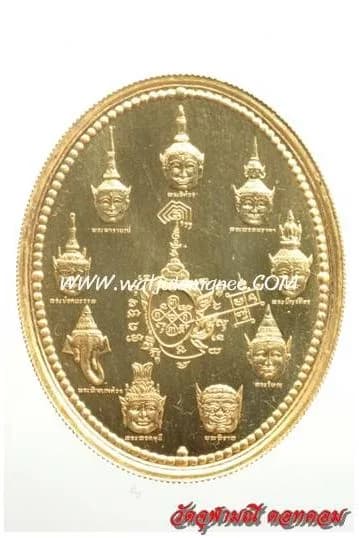
The Thewabodi medal, or “nine-head medal,” of Wat Chulamanee, B.E. 2542 (1999), designed and created by Phra Ajarn Itthi, with dies cut and struck by craftsmen of the Royal Mint. The front bears nine great teacher-deities encircling the Phra Lak Golden-Face yantra; the reverse bears the Maha Chakraphat Tratharat (Great Emperor) yantra.
The Thewabodi medal (some call it the “nine-head medal,” others the “likay medal”) was designed and created by Phra Ajarn Itthi of Wat Chulamanee, Samut Songkhram. Its dies were cut and struck by craftsmen of the Royal Mint, and it was made in B.E. 2542 (1999), the year inscribed on the reverse of the medal itself.
The Front — the Nine Great Teacher-Deities
On the front of the medal, the Phra Lak Golden-Face (Phra Lak Na Thong) yantra is set at the center, encircled by the heads of nine great teacher-deities, as follows:
Phra Isuan (Shiva) — the deity who destroys all evil
Phra Phrommathata (Brahma the Creator) — the deity who creates the world
Phra Narai (Narayana) — the deity who preserves goodness
Phra Witsanu (Vishnu) — the deity of all craftsmen
Phra Khanet (Ganesha) — the deity of arts and learning
Phra Panchasikhon (Pañcasikha) — the deity of music
Phra Prakhonthan — the gandharva deity
Phra Phirap (Bhairava) — the asura-deva
Phra Ruesi (Phra Phrotmuni) — the sage, grand teacher of all the arts
The Reverse — the Great Emperor Yantra
On the reverse is the Maha Chakraphat Tratharat (Great Emperor) yantra, a most sacred yantra, encircled by the “Great Subduing, Great Quelling” incantation of Phra Upajjhaya Khong Dhammajoto of Wat Bang Kaphom — who was the preceptor of the venerable Luang Pho Nueang Kovito. Along the upper edge appears the inscription “Thewabodi Medal, Wat Chulamanee,” and along the lower edge “Amphawa District, Samut Songkhram, B.E. 2542.” The rim of the medal is milled like a cog wheel, which makes it difficult to counterfeit.
Photographs of the various materials
Gold
Alpaca (nickel alloy)
The Numbers Produced
Gold — 30 medals
Silver — 1,000 medals
Nickel — 40,000 medals
The Consecration
Phra Ajarn Itthi gave the utmost importance and care to every rite — especially the empowering of the Great Emperor yantra, which requires auspicious timing and much elaborate ceremony. And so this Thewabodi medal, besides being entered into the rites of Wat Chulamanee on many occasions, was also brought to be consecrated in the great consecration rite of the Phra Phichit edition at Wat Tha Luang in B.E. 2543 (2000).
Most importantly, this medal was entered into the Great Emperor consecration rite of the Kring Naresuan Ong Dam, the 100th-anniversary edition of Phitsanulok Phitthayakhom School, at the Wihan of Phra Phuttha Chinnarat around the middle of B.E. 2542 (1999). On that occasion Phra Ajarn Itthi was invited to sit in meditation and to inscribe a golden Great Emperor takrut offered to His Majesty the King (Rama IX). The host invited three venerable monks expert in the Great Emperor yantra to inscribe the takrut together on that occasion, namely:
Phra Khru Sangkharak (Luang Pu Chaloem) of Wat Phra Yat, Phra Nakhon Si Ayutthaya
Phra Khru Sophitwiriyaphon (Phra Ajarn Itthi) of Wat Chulamanee, Samut Songkhram
Phra Khru Yan-udom (Phra Ajarn Tio) of Wat Mani Chonlakhan, Lopburi
Why the Great Emperor Yantra was Placed on the Reverse
As for the original reason for placing the Great Emperor yantra on the reverse of the Thewabodi medal, Phra Ajarn Itthi once said:
In Phra Ajarn Itthi's own words
“Because it occurred to me that once I had inscribed this takrut for a disciple, I would not be able to keep inscribing them forever — so I made the Thewabodi medal with the Great Emperor yantra on the back.”
And this, indeed, is the compassion he holds for his disciples — wishing that everyone might have something truly good to use, whether disciples of the earliest days or of later times.
Note: this account is compiled from a recorded telling of how this edition came to be made (compiled by Khun Chang Bang Chak), in order to document the origin of this edition. It is not intended for any purpose of trade.