
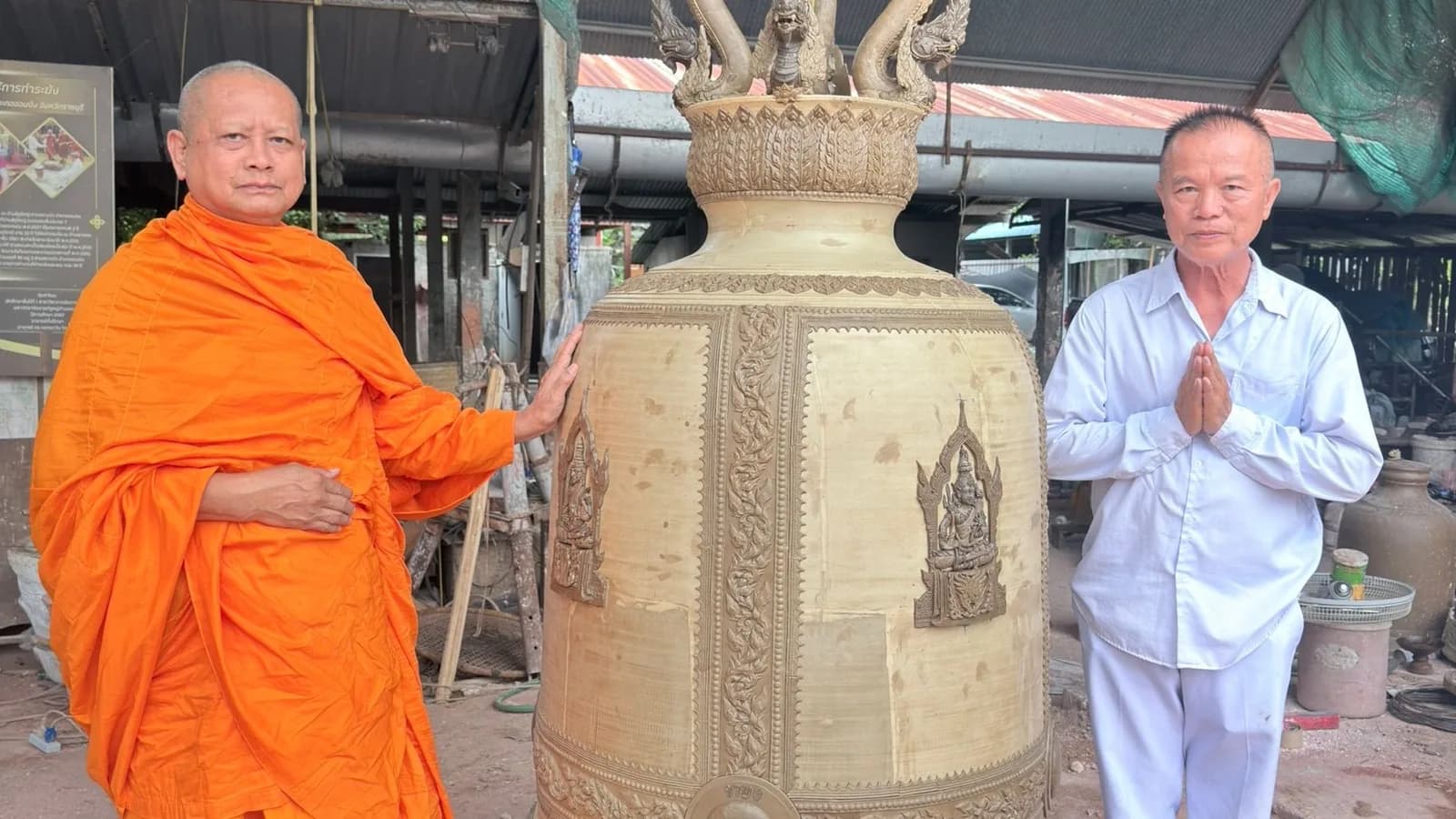
Casting Ceremony for the “Four Devas” Bronze Bell, Wat Chulamanee
Date
5 September 2026
On Saturday 5 September 2026, 14.39–16.09 hrs, beside the Phra Phutthachinnarat hall at Wat Chulamanee — the ceremonial pouring of a bronze (“long hin”) bell of 12 kam, 36 inches across, 77 inches high and weighing 800 kilograms, bearing four devas in flame-arch niches around its body, with the official programme, the fourteen elder monks presiding, photographs from the ceremony day, and photographs of the work in progress at the foundry.
The casting ceremony for the “Four Devas” bronze bell of Wat Chulamanee will be held on Saturday 5 September 2026, from 14.39 to 16.09 hrs, on the ground beside the Phra Phutthachinnarat hall at Wat Chulamanee, Samut Songkhram.
The bell is cast in bronze and bears four devas seated in flame-arch niches (ruean kaeo) set around its body — the origin of the name “Four Devas bell”. The master model has been sculpted and the clay mould built up over it; the bell now awaits the appointed hour for the pouring.
Ceremonies held on the same occasion
According to the temple's programme, the ceremonies of the day comprise:
The casting of a Buddha image (the auspicious first pour)
The casting of the bell in bronze
The casting of two images of Tao Wessuwan, the Prap Man Prathan Phon (“subduing Māra, bestowing blessings”) edition, 3.66 metres high, to be enshrined at Wat Wisit Bunyawat in Bangkok — commissioned by Khun Pom Winit together with a company of artists and actors.
The consecration (thewaphisek) of images of Phra Phirap, the Khum Duang Khum Chata (“guarding the horoscope, guarding the destiny”) edition — commissioned by Asst. Prof. Dr. Chunlachat Aranyanak together with his students of the yaksha khon tradition.
Programme
10.30 hrs — Merit-making rite of dedication to the departed (thaksinanupathan)
11.00 hrs — Offering of the midday meal to the monks
14.00 hrs — The brahmin officiants perform the propitiation of the devas and the honouring of the auspicious hour
The ritual dance of Phra Phirap in propitiation
14.39 hrs — The master of ceremonies invites the presiding layman to light incense and candles before the Triple Gem
The precepts are requested; the monks confer the precepts
Offering of requisites to all the assembled monks
The assembled monks chant the verses of rejoicing; the water of dedication is poured and the blessing received
The presiding monk is invited to light the Victory Candle; the monks chant the verses for its lighting
The parittas are requested
The monks chant the Mahāsamaya Sutta
The keji masters take their seats in meditation, empowering the work
16.09 hrs — The great auspicious hour — the pouring of the molten metal begins
The monks chant the Chayamangala verses of victory and blessing
The senior elders perform the extinguishing of the Victory Candle (the monks chant the verses for its extinguishing)
The keji masters sprinkle the lustral water
Celebratory singing by Keng Thachaya
The ceremony concludes
The elder monks seated in meditation to empower the ceremony
Somdet Phra Maha Ratchamongkhonmuni (Somdet Thongchai), Wat Traimit Witthayaram Worawihan, Bangkok
Phra Thep Watchara Thammasophon (Luang Pu Maha Sila), Wat Phra That Muen Hin, Kalasin
Phra Ratcha Watcharachan Sophon (Luang Pu Woen), Wat Burapha Khok Khruea, Kalasin
Phra Ratcha Watchara Phawanaphithan (Luang Pho Suang), Wat Rakhang Khositaram Woramahawihan, Bangkok
Phra Ratcha Phatthanasunthon (Luang Pho Mu Khiao Kaeo), Wat Song Tham Worawihan, Samut Prakan
Phra Ratcha Phawana Wachirachan (Luang Pho Surasak), Wat Pradu Phra Aram Luang, Samut Songkhram
Phra Ratcha Wachira Thammakhosit (Chao Khun Ton), Wat Rakhang Khositaram Woramahawihan, Bangkok
Phra Nanthawiriyaphon (Luang Pho Ang), Wat Yai Sawang Arom, Nonthaburi
Phra Samut Wachirasophon (Luang Pho Itthi), Wat Chulamanee, Samut Songkhram
Phra Phawana Wachiramongkhon (Luang Pho Somphon), Wat Pa Thammasophon, Lopburi
Phra Khru Wisut Samutkhun (Luang Pho Anan), Wat Bang Phli Noi, Samut Prakan
Phra Khru Metta Mongkhon Wisit (Luang Pho Watcharin), Wat Wisit Bunyawat, Bangkok
Phra Khru Nirutti Borihan (Luang Pho Ing), Wat Wetawan Thammawat (Wat Soeng Wai), Bangkok
Phra Maha Itsara Ñāṇissaro (Phra Maha Thaen), Wat Dawadungsaram, a royal monastery, Bangkok
The programme and the list of elder monks above are transcribed from the temple's own document, last revised 31 August 2026; details may change as circumstances require.
Dimensions and weight
Size — 12 kam · 36 inches (91.44 cm)
Height — 77 inches (195.58 cm)
Weight — 800 kilograms
Bronze bells (“long hin” bronze)
A bronze bell — known in Thai as a “long hin” bell — is cast from an alloy of copper and pure tin. It is strong and durable, and is prized for a voice that is bright and resonant, soft and deep, and that carries far longer than bells of other metals. Such bells are made as offerings to the Buddha and hung in the bell towers of temples.
The metal — an alloy of copper and tin in the proper proportion, finished by the stone-polishing process (long hin), which gives the metal its density.
The voice — resonant, deep and mellow, with a power that carries into the distance.
Durability — it withstands impact and does not crack easily.
The ornament of the bell
The finished master model is covered with Thai ornament over its whole body:
Four devas — seated in flame-arch niches on all four sides of the bell, each in full royal attire and each enthroned above a base bearing a different emblem (a demon mask, an elephant, a bull, a lion mask), with a Khom-script syllable inscribed beneath.
The crown — formed of nagas coiling upward to carry the suspension ring.
Four striking bosses — each inscribed above with a Thai word: “lap” (gain), “chok” (fortune), “ngoen” (silver) and “thong” (gold).
The bands of ornament — scrolling vine and kanok flame motifs within the pilasters, prachamyam rosettes dividing the registers, and tiers of lotus petals at the shoulder and the lip of the bell.
Progress of the work
Luang Pho Itthi — Phra Samut Wachirasophon Vi., abbot of Wat Chulamanee, travelled in person to the foundry to see how the work was progressing. A board installed at the foundry identifies it as a “bell-making learning centre” at Ban Chat Yai, Moo 3, Rang Bua Subdistrict, Chom Bueng District, Ratchaburi, the workshop of the craftsman Somphon Thamthae.
This set of photographs records the work in sequence: sculpting the devas and their arches in clay on iron plates, taking plaster moulds from them, pressing out the ornament, building the master model of the bell, and finally packing clay over the model layer by layer with iron framing and wire mesh to form the mould for the pouring on the day of the ceremony.
To join in sponsoring the casting of the “Four Devas” bronze bell of Wat Chulamanee
Siam Commercial Bank, account name “Wat Chulamanee (Buddha-image casting)”, account no. 403-121695-3
For further information, tel. 098-823-9595