
Clearing Up the Doubts — Luang Pho Nueang's First-Edition Medal of B.E. 2511 (1968) and Ecclesiastical-Rank-Promotion Medal of B.E. 2517 (1974), Wat Chulamanee
Setting the record straight on two medals of Luang Pho Nueang Kovito — the first-edition medal of B.E. 2511 (1968) (the "no nu" code above the head, the "na" code on the saṅghāṭi robe, and the "no nu" code beside the ear that Luang Pho Itthi stamped on his master's orders before his passing) and the ecclesiastical-rank-promotion medal of B.E. 2517 (1974) (full ta kai and flat ta kai dies), together with the miracle of the yantra plate that would not melt.
Amulet record — clearing up the doubts about the first-edition medal of B.E. 2511 (1968) (the "no nu" code beside the ear) and the ecclesiastical-rank-promotion medal of B.E. 2517 (1974) (full ta kai and flat ta kai dies) of Luang Pho Nueang Kovito, Wat Chulamanee
Over the years all sorts of tales have been told. Many people, having heard a story from someone else, pass it along without knowing the facts — especially when it comes to Luang Pho Nueang's first-edition medal of B.E. 2511 (1968) and his ecclesiastical-rank-promotion medal of B.E. 2517 (1974). This article has therefore been compiled to clear up the doubts, so that everyone may read it and come to know the truth.
Luang Pho Nueang's First-Edition Medal, B.E. 2511 (1968)
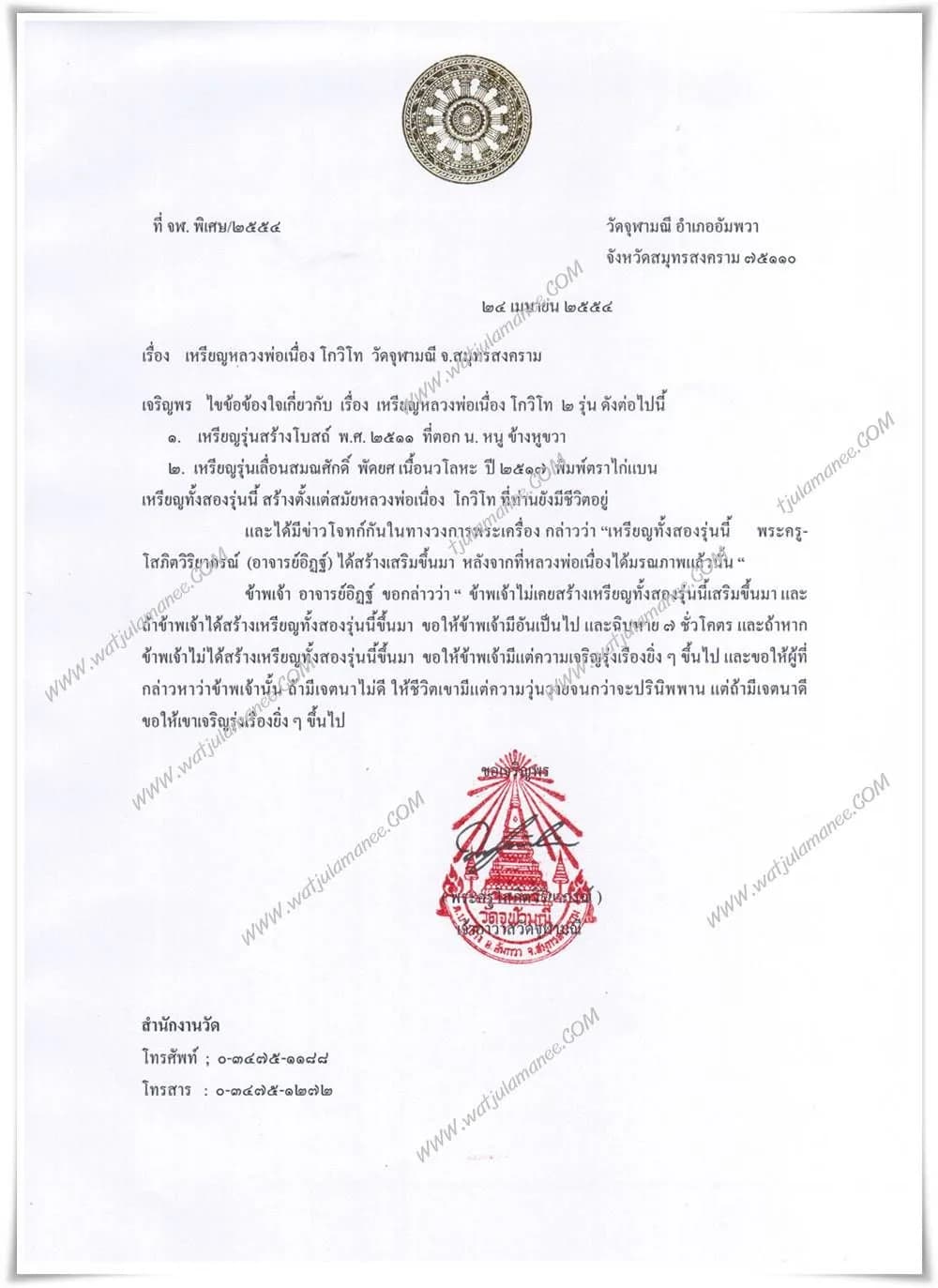
The first matter concerns Luang Pho Nueang's first-edition medal of B.E. 2511 (1968) with the "no nu" code beside the ear of Luang Pho Nueang's image. People say all sorts of things about it — that Luang Pho Itthi produced this batch as a supplement after Luang Pho Nueang had passed away. What are the facts? Let us read on and learn the truth.
This first-edition medal of Luang Pho Nueang, B.E. 2511 (1968), was made in a total of about 50,000 pieces. Luang Pho Nueang had the disciples who were then helping with his work stamp the codes. The first set of codes to be stamped and offered for veneration in those days was the "no nu" (น) code above the head of his image on the medal — some 5,000 medals in all were stamped this way, and Luang Pho gave out several thousand of them.
The medals that were given out came both inscribed and uninscribed, but most of this batch were inscribed — both inscribed with an iron stylus and inscribed with a pencil. In those days most of Luang Pho Nueang's disciples would polish this batch of medals and show them off to one another, competing over whose medal had the more beautiful golden surface. As a result, medals stamped with the "no nu" code above the head that remain in original condition are very hard to find.
Later, after Luang Pho Nueang had inscribed a great many of this batch, he found that whenever he inscribed a medal the stylus would catch on the "no nu" code above the head. Luang Pho Nueang therefore had the "na" code (Khmer script) stamped on the saṅghāṭi robe instead. Medals with the "na" code on the saṅghāṭi are the most numerous of all — nearly forty thousand medals.
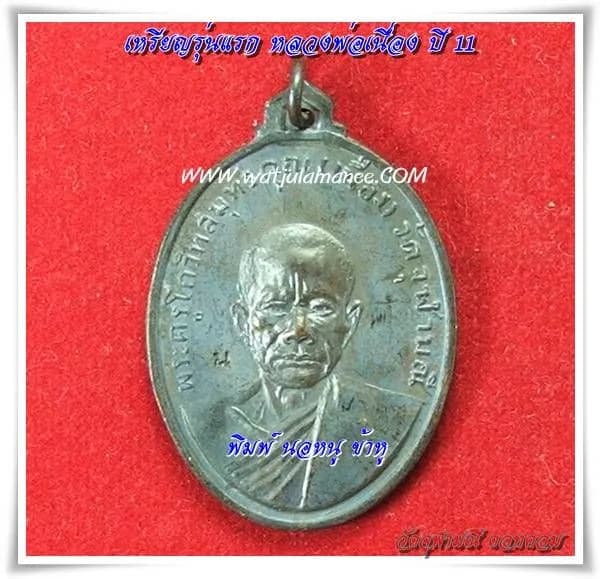
For both of the types described above, Luang Pho Nueang would inscribe the medals in the night, every day, only a few dozen medals a day. Once he had finished inscribing them he would coat the medals with a lacquer. That is why one can observe that, old as this batch is, it still retains the sheen of the lacquer coating.
The 2,000 Medals on Which Luang Pho Itthi Stamped the "No Nu" Code Beside the Ear
During the B.E. 2530s (1980s), before Luang Pho Nueang passed away, he instructed the temple committee members who were caring for him at the hospital to go and tell Luang Pho Itthi (who in the B.E. 2530s (1980s) was still an ordinary resident monk of the temple) to take the "no nu" code that Luang Pho Nueang had kept and use it to stamp the 2,000 pieces of his first-edition medal that were being kept in the safe.
Luang Pho Nueang gave the instruction to Luang Pho Itthi because Luang Pho Itthi had attended upon Luang Pho Nueang all along, ever since he was a novice, and so he knew where Luang Pho Nueang kept the "no nu" code. However, the number of medals did not amount to a full 2,000, because some bags had already had medals removed from them, and no one could say who had taken them out. The opening of the safe on this occasion was carried out by the temple committee.
Luang Pho Nueang further instructed that this batch of medals be sold to raise money for his funeral, so that temple funds would not have to be used for the ceremony. Luang Pho Itthi therefore took all of the roughly 2,000 medals to stamp the code, but he foresaw that if he stamped the "no nu" code above the head it would be the same as what had been stamped before. He therefore changed the position of the stamp, placing it beside the ear above the right shoulder of the medal, in order to distinguish these medals from the others. The surface of this batch of medals has no coating; the color of the surface is a dull black, differing from the "no nu" above-the-head medals and the "na" saṅghāṭi medals. Luang Pho Itthi also ordered new boxes made specifically for this batch of medals.
The Remaining First-Edition Medals from Luang Pho Nueang's Time
In addition, from Luang Pho Nueang's time there was another quantity of first-edition medals, both those already stamped with a code and those not yet stamped. The temple had some enameled to be given out at the Kathin ceremony, and had some gold-gilded to be given to the cooks who came to help with the work at the temple; and there was yet another portion that Luang Pho Nueang presented to other temples as he saw fit.
The Ecclesiastical-Rank-Promotion Medal, B.E. 2517 (1974) — Full Ta Kai and Flat Ta Kai
Now it is the turn of Luang Pho Nueang's ecclesiastical-rank-promotion medal of B.E. 2517 (1974), the full ta kai (chicken-eye) and the flat ta kai — let us look at how these came to be.
This ecclesiastical-rank-promotion medal of Luang Pho Nueang, B.E. 2517 (1974), was made by the mayor of Amphawa at the time, Mayor Bunkoet, the owner of the Sawan Osot pharmacy located in Amphawa Market. He had it made and offered it to Luang Pho Nueang in celebration of the ecclesiastical rank that Luang Pho received at that time, in B.E. 2517 (1974).
As for the number produced, no one can say for certain how many were made. The first batch was the batch struck first, and so the ta kai on the reverse were still clear dots — the striking die had no problems yet and was still sharp. Luang Pho Nueang gave out and sold these medals until they were nearly gone. When he foresaw that the remaining number would surely not be enough, he ordered the temple committee to have more medals struck. But because the metal of the later batch was hard, the striking die began to break down. This can be seen from the medals that came out: the lettering on the reverse began to collapse and the ta kai began to lose their dot-like form. The factory struck them until the chanuan (sacred alloy) ran out, yielding this batch of no more than about 3,000 medals.
The Miracle of the Yantra Plate That Would Not Melt
The miracle of this batch of medals appeared from the very start of the casting of the chanuan. Luang Pho Nueang gave the owner of the foundry a copper plate inscribed with yantra characters, along with a further quantity of chanuan. When the craftsman cast the chanuan and the yantra plate that Luang Pho Nueang had given him, it turned out that the yantra plate would not melt. The owner of the factory therefore had to hurry back to Luang Pho Nueang once more to inform him of what had happened. Luang Pho Nueang then inscribed another yantra plate; this time both yantra plates melted with ease. It was an unbelievable event.
To say it was mere coincidence hardly seems right, because the first casting, which Mayor Bunkoet had requested to make, was the full ta kai die, and the second casting, which Luang Pho Nueang ordered to be made, was the flat ta kai die. At the second casting the owner of the foundry again came to receive the yantra plate and the chanuan from Luang Pho Nueang as before. When he cast the chanuan and the yantra plate, Luang Pho Nueang's yantra plate again would not melt, just as the first time. The owner of the foundry therefore had to hurry back to the temple once more to ask Luang Pho Nueang for a yantra plate as before.
When he reached the temple it turned out that Luang Pho Nueang's copper plates had run out. Luang Pho Nueang therefore said to Luang Pho Itthi (who at that time was still an ordinary resident monk of the temple) to bring over the copper plate that Luang Pho Itthi had inscribed with characters, so he could take a look. When Luang Pho Itthi brought his copper plate to show him, Luang Pho Nueang sat contemplating it for a moment and then said, "It will do," and handed it to the owner of the foundry. When it reached the foundry and the chanuan was cast anew, the copper plate melted with ease. There you have it — could such a thing be coincidence twice over?
Of this event Luang Pho Itthi later recounted that, when the owner of the foundry came to receive the yantra plate from Luang Pho Nueang, he would go and wait for the owner of the foundry at his vehicle, in order to ask to see the yantra that Luang Pho Nueang had inscribed, and would then study it and try inscribing it on his own copper plate. So when the factory owner came a second time to collect one, it was the same yantra as the one Luang Pho Nueang had given before. But the important point is this: on this second occasion, how did Luang Pho Nueang know that Luang Pho Itthi had inscribed a yantra plate in his room, when Luang Pho Itthi had never once mentioned the matter to Luang Pho Nueang?
So then, everyone — which do you think is the more worthy to use and to keep: the full ta kai that the disciple had made and offered, or the flat ta kai that Luang Pho Nueang ordered struck himself?
Written and compiled by
Ko Mae Klong