
Chatting About Luang Pho Wat Ban Laem — The Legend of the Mae Klong River (EP.2)
The legend of the mantra "นะ มะ ระ อะ นะ เท วะ อะ" that Luang Pho Wat Ban Laem granted to subdue the cholera epidemic of B.E. 2416 (1873), leading to the making of the Champi-form medallion of Luang Pho Wat Ban Laem with Tao Wessuwan on the reverse, for the affairs of the Sangha of Samut Songkhram Province.
A Tale Retold — Chatting About Luang Pho Wat Ban Laem, the sacred Buddha image and legend of the Mae Klong River (EP.2)
The Revered Father of Wat Ban Laem
The elders of Mae Klong have long told one another, "When it comes to sickness and illness, you must go and ask the Revered Father of Wat Ban Laem — if it is not beyond one's allotted karma, a cure is certain." Together with the present COVID situation, this brought my mind back to the stories of the miraculous powers and sanctity of Luang Pho Wat Ban Laem that I had once heard.
The Mantra That Subdued Cholera
When cholera broke out in the Year of the Rooster, B.E. 2416 (1873), many people at Mae Klong perished, until the whole town fell silent. No one wished to leave their homes, and no one would cremate the dead, for it was believed to be a plague of spirits and pestilence. At that time, Phra Sanit Samanakhun (Net), then the abbot of Wat Ban Laem (Wat Phet Samut Worawihan), dreamed that Luang Pho Ban Laem — the standing Buddha image in the alms-bowl posture within the ordination hall — came to give him a mantra to ward off cholera, telling the abbot to go and copy the mantra written upon its hands. He rose and woke Khun Prachaniyom (Ong Prachaniyom), who was then a temple boy, so that they might enter the ordination hall together in the dead of night. He held up a candle to examine both hands of Luang Pho Ban Laem, and saw upon the right hand the characters "นะ มะ ระ อะ" and upon the left hand the characters "นะ เท วะ อะ." He thus copied the mantra and used it to make holy water for the villagers to drink and to bathe in, and it came to pass that the various diseases and the epidemic grew quiet from that time onward.
นะ มะ ระ อะ นะ เท วะ อะ
The Meaning of the Mantra
Concerning this mantra "นะ มะ ระ อะ นะ เท วะ อะ" of Luang Pho Wat Ban Laem, Master Thep Sunthonsarathun, the recorder of the history of Luang Pho Wat Ban Laem, once put the question to Somdet Phra Thiranyanamuni (Sanit Khemachari Mahathera, P.Th.9) of Wat Pathum Khongkha, but even he could not determine what it meant. It was therefore surmised that the said mantra was likely an abbreviation of the words of the Buddha.
"นะ มะ ระ อะ" means "an arahant does not die" (นะ means "not," มะ ระ means "death," อะ means "arahant")
"นะ เท วะ อะ" means "an arahant is not a deva" (นะ means "not," เท วะ means "deva," อะ means "arahant")
Toward the Making of the Champi Medallion of Luang Pho Wat Ban Laem
Over the past year or two, the COVID epidemic has brought people to sickness, and the economic downturn has affected everyone, monks included. Yet the mission of administering the affairs of the Sangha of Samut Songkhram Province must go on, and this is a heavy burden upon the ecclesiastical dignitaries and the governing Sangha of Samut Songkhram. Phra Phawanawisutthisophon (Luang Pho Maha Surasak) of Wat Pradu, a royal monastery, the Ecclesiastical Governor of Samut Songkhram Province, therefore consulted together with Phra Khru Sophitwiriyaphon (Luang Pho Itthi) of Wat Chulamanee, the Ecclesiastical Subdistrict Head of Bang Chang (Zone 1), and they jointly resolved to make the sacred object — the Champi-form medallion of Luang Pho Wat Ban Laem with Tao Wessuwan on the reverse — to be offered to the people to make merit and reserve, raising funds to cover the expenses of the six areas of the Sangha's affairs in Samut Songkhram Province, which comprise:
Administration
Buddhist education
Educational welfare
Propagation of Buddhism
Public works
Public welfare
The Propitiation Ceremony
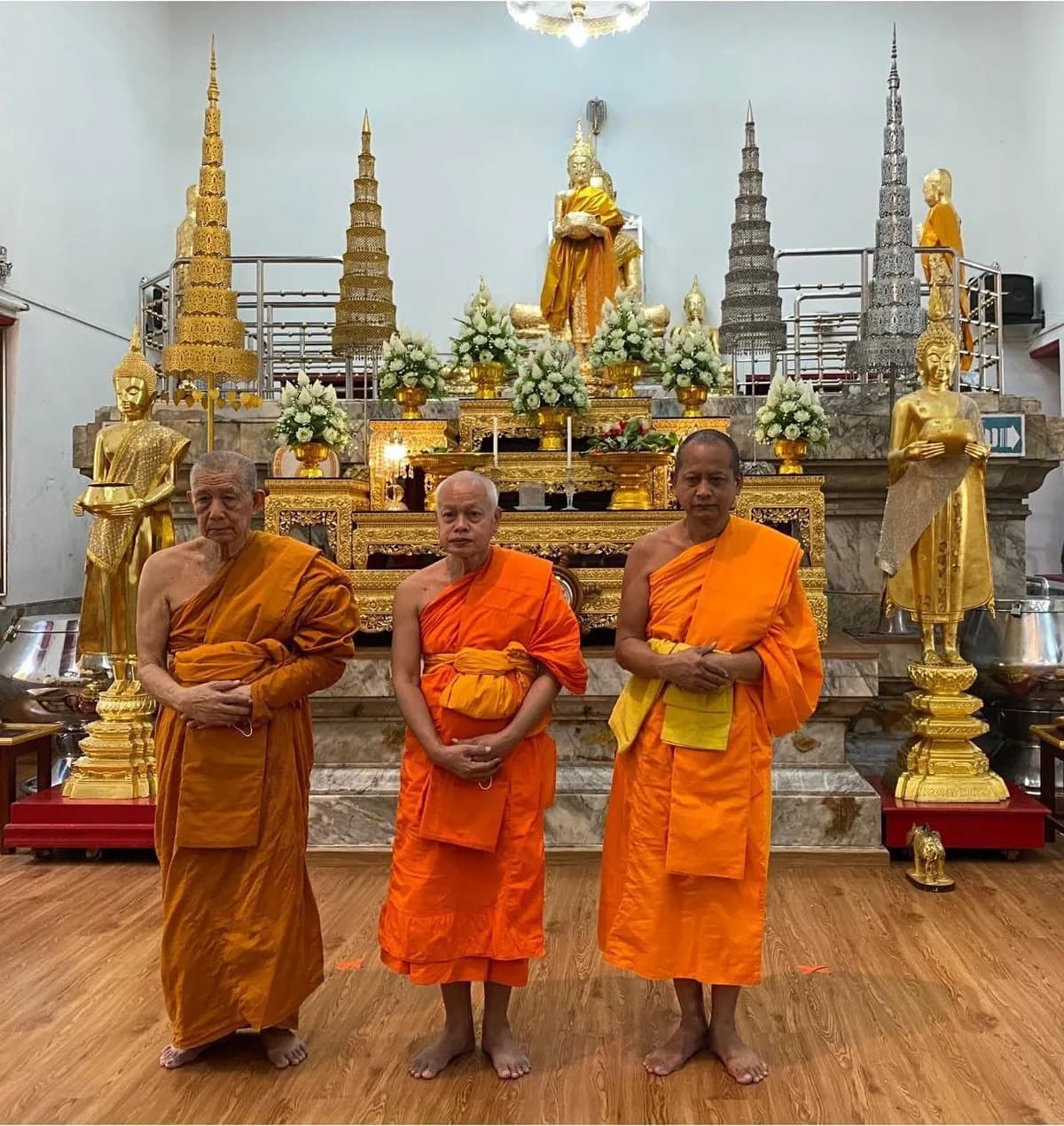
As for the propitiation ceremony before Luang Pho Wat Ban Laem to seek permission to make the said medallion, it was duly completed on the morning of 11 March 2021, at 9:35 a.m. It was presided over by Phra Samutwachirasophon (Sophon Dhammasophano), Advisor to the Ecclesiastical Governor of Samut Songkhram Province and Acting Abbot of Wat Phet Samut Worawihan; Phra Phawanawisutthisophon (Luang Pho Maha Surasak) of Wat Pradu, a royal monastery, the Ecclesiastical Governor of Samut Songkhram Province; and Phra Khru Sophitwiriyaphon (Luang Pho Itthi) of Wat Chulamanee, the Ecclesiastical Subdistrict Head of Bang Chang (Zone 1), who together served as the presiding elders of the ceremony, with Master Korakot Suriyasangkat as the learned reader of the invocation.
In Closing
As for the form the medallion will take in this making — what Buddhist artistry it will bear, what sacred characters and yantra numerals it will carry, how exquisitely beautiful it will be, and when it will be opened for reservation — I would like everyone to follow the details and the clear pictures once more from the page of Master So. Suraseni of Wat Chulamanee. But let me hint that it will be no less beautiful than the "Champi Debt-Relief" medallion of Phra Phuttha Chinnarat, that is certain. And this now marks the second sacred Buddha image, revered by the town, to be enshrined upon a Champi-form medallion of Wat Chulamanee. Do not be complacent, or you will miss the wagon as with the Chinnarat Champi medallion, and then say that I did not warn you. For this evening, may everyone enjoy "riches multiplied, good fortune for all time," sleep well with sweet dreams — good night to you all.
Compiled by
Khun Chang Bang Chak (Komsan Pisalsongkram)