
Sacred amulets
Past editionMaha Thewa Borommakhru Medal — Wat Chulamanee, B.E. 2541 (1998)
B.E. 2541
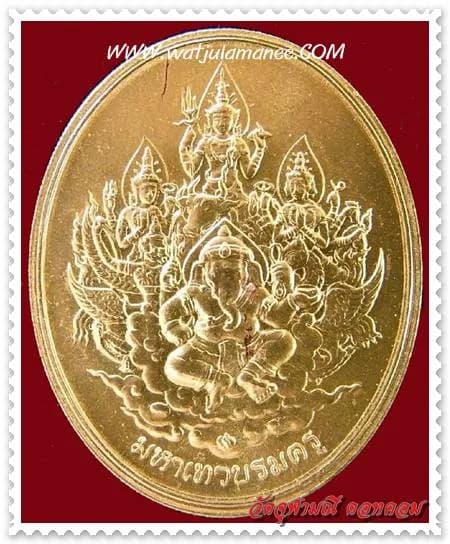
A deity-lineage medal of Wat Chulamanee, stamped by the Royal Thai Mint, Treasury Department, in B.E. 2541, empowered over many years, gathering the great deities into a single medal — Ganesha, Narayana riding Garuda, Shiva riding the bull, Brahma riding the swan, and Tao Wessuwan.
The Maha Thewa Borommakhru Medal of Wat Chulamanee is another deity-lineage medal well worth carrying, one that devotees of Ganesha should not miss. It is a beautiful medal, finely crafted and made with care, designed with grace in both learning and art. The medal was stamped by the Royal Thai Mint, Treasury Department, created in the Buddhist year B.E. 2541, and empowered over the course of many years, gathering the supreme great deities together into a single medal.
Photographs of the various materials
Gold
Silver
Brass (aluminium bronze, coinage alloy)
The Sacred Features of the Medal
The front of the medal comprises Narayana riding Garuda, Shiva riding the bull, and Brahma riding the swan, with Ganesha — the great deity of wisdom and success — at the center.
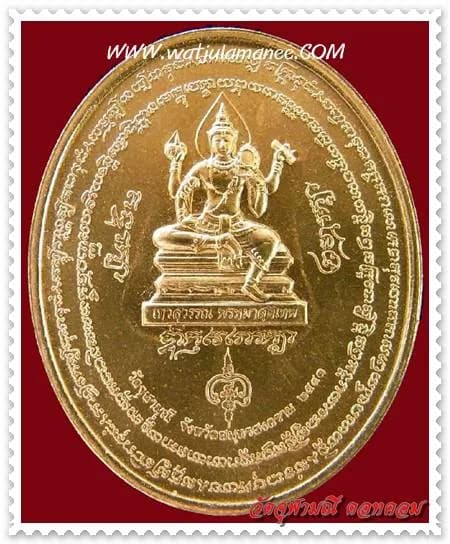
The reverse of the medal bears the figure of Thewasuwan Phrommasutithep (Tao Wessuwan), together with yantra encircling the medal in two further rings.
The Numbers Produced
Gold material — 40 medals
Silver material — 1,000 medals
Brass material (aluminium bronze, coinage metal) — 10,000 medals
Narayana Riding Garuda
The Brahmanic Purāṇa scriptures relate that Shiva wished to create the heavens and the world of humankind, which was a great undertaking, and so he needed a helper. He drew his left hand across his right hand until there arose from it a deity named Vishnu, or Narayana, whom he then charged with the duty of governing and protecting the world, and of subduing those who bring trouble upon humans and the beings of heaven.
Narayana has a body the color of the tabaek blossom, with 4 arms holding different weapons — the mace, the trident, the discus, and the conch — and wears a crown of victory. He resides in the midst of the Ocean of Milk upon the back of the great serpent Ananta Nāgarāja, and uses Garuda as his mount. His consort is Lakshmi. The scriptures further relate that Narayana descends in incarnation as both human and animal, by the command of Shiva or by the invitation of the assembly of gods and humans. His incarnations to aid the human world number 10 in all, and one of these was his descent as Rama in the literary epic the Ramakian. Thai people also believe that the monarch is one of the incarnations of Narayana; this may be seen in that whenever "the King" travels anywhere, the Garuda banner must be borne along with him, and wherever he resides, the Garuda banner always appears there.
The tale of Narayana riding Garuda has thus been a Brahmanic belief since ancient times. Beyond Thailand, Indonesia also holds this belief, for it once professed Brahmanism; Indonesians call Garuda "Garuda" and use the image of Garuda as the emblem of their nation, and images of Narayana riding Garuda appear throughout the country. As for Cambodia (the Khmer), or the ancient Khom, it too was once a land of Brahmanism, and so its antiquities have long borne images of Narayana riding Garuda — mostly free-standing votive figures of various sizes, cast in bronze with a jade-green patina, while small figures made to be worn around the neck are very rare.
Shiva (Isvara) Riding the Bull
Phra Isuan, or Shiva (English: Shiva), whom the Chinese call Yuhuang Shangdi (a Chinese name for Shiva), is a deity in the belief of the Hindus. His mount is the white bull named Ushuparat. Shiva is the great deity of destruction; his body is white, but his throat is black because he once drank poison. He has 3 eyes, the third of which lies in the middle of his forehead and normally remains closed, for its power is exceedingly fierce — whenever it opens, it burns all things to ashes. He resides upon Mount Kailasa, the center of the universe, and his consort is Uma. The form of Shiva most often appears as a man with long hair, with the moon as a hairpin, a rosary or human skulls as an ornament across his chest, a cobra coiled about his throat, and a tiger skin as his garment, which is the raiment of ascetics. Shiva may be worshipped through veneration of the Shiva lingam, which is the symbol standing for him.
The bull named Ushuparat is the white bull that serves as Shiva's own mount; it is sometimes called the bull Nandirāja, and its birth was no ordinary one. In the great churning of the Ocean of Milk by the assembly of gods, many wondrous things arose, and the cow Surabhi was one of the marvels that came forth. Kashyapa wished to have the cow Surabhi as his mount, but she was of the female sex; so he transformed himself into a bull and mated with the cow Surabhi, until she gave birth to a calf, a bull of pure white with excellent marks conforming to the treatises. Kashyapa therefore gave him the name Nandi (Nandin) and presented him to serve as Shiva's mount thereafter.
Some scriptures give a different account of the origin of the bull Nandirāja, saying that he was formerly a deity in the heavens named Nandi, whose duty was to protect and watch over the four-footed animals dwelling in the forest near Mount Kailasa, and who often transformed himself into a white bull so that Shiva might ride to various places, until he became as it were Shiva's own mount. Nandi is also the chief of all Shiva's divine attendants, and a musician; he once joined in the dance with Shiva, taking on the duty of beating the drum to keep time while Shiva danced on important occasions. For this reason those who worship Shiva also favor the worship of the bull Nandi, honoring him as a sacred bull that stands as a symbol of Shiva. It is out of reverence for the bull Nandi that the Hindus do not favor the killing of cattle.
Shiva is the great deity supreme in the universe. He bestows wondrous blessings only upon those diligent in doing good and steadfast in morality. Whoever conducts himself in dedication to him and then desires anything, he will soon grant that wondrous thing; but if, once the desire is fulfilled, that person later strays from goodness, calamity will befall his life, for Shiva at once becomes the deity of destruction. It is believed that Shiva can miraculously drive away and cure sickness and disease; whoever is in distress of any kind, if he makes offerings and worships and asks to be freed from suffering, Shiva will likewise grant the blessing of release from the depths of suffering.
Brahma
Brahma is the Creator God, who ordains the course of all things and determines the destiny of every human life, and so knows the movements of all living beings; the great events of the world all lie within Brahma's sight. He is one of the three supreme great deities of the Trimurti, and always heeds the prayers of the faithful; those who worship Brahma and do good will be granted the fulfillment of their desires. Brahma has many names, such as Phra Phrommā, Phra Phrahmā, Phra Phrommathada, Thao Maha Phrom, Prajāpati, Ādikavi, Ātmabhū, Lokādhipati, and so forth. Brahma's animal mount is the swan.
There are many accounts of Brahma's origin. The Purāṇa scriptures of the Brahmans who hold Vishnu to be supreme (the Vaishnava sect) say that Brahma was born within a lotus that rose from the navel of Vishnu, meaning that Vishnu existed before all things, and that when he wished to create the world he gave birth to Brahma for this task. But the Purāṇa scriptures of the Brahmans who hold Shiva to be supreme (the Shaiva sect) say that Shiva drew one hand across the other, and light arose in his hand, and Brahma came forth from that light — for Shiva wished to create the world and gave birth to Brahma for this task; and by this legend it is Shiva who existed before all things.
Brahma is the deity of creation, endowed with the power to ordain the destiny of life, controlling all things to unfold according to the conditions of the law of karma; he is therefore the protector of the good and the punisher of those who do evil. Those bound by defilement and craving are destined to lives of nothing but hardship and misery, while those whose hearts are generous toward others Brahma causes to have happiness and fullness in life. Sacrifice for the common good is an offering of loyal devotion to Brahma, and he will grant to the one who sacrifices nothing but happiness for all time. When the faithful chant in worship of him, he bestows wisdom in their livelihood, protects them from enemies, grants strength and enlightened knowledge, points out the way to resolve their troubles, and confers purity of spirit.
Brahma delights in quiet and calm, free of turmoil; he is gentle of heart and ever loves the living beings he has created. When the faithful wish to pay homage, he delights in simple arrangements — made with earnest intent yet not grand or troublesome. He delights in the chanting of "Sak Chit Ekam Brahma" or "Om Aham Brahma Asmi" a hundred or a thousand times over, and in sitting in meditation with the mind fixed upon him; for he teaches that to sit still recollecting him, to eat vegetarian food, and to refrain from going out to bring trouble upon others is the finest way to repay Brahma's grace.
Brahma's weapons are of 4 principal kinds, namely:
The rosary — the chanting of prayers to Brahma to spread loving-kindness to all living beings.
The lotus — the beauty of the Dhamma and of goodness; he teaches humans to do what is good and to be ever kind to others.
The scripture — establishing oneself in what is good and right, the study of chants and of yoga in order to draw near to the Lord God.
The water pot — the kamandalu, or the kalasha pot, in which ascetics draw water from the River Ganges for use in the ceremonies of worshipping the various deities (pure holy water).
Besides these 4 principal weapons, there are many more, according to how the artisan imagines and sculpts or paints them to enhance the meaning — such as the bow, the spear, the mirror, the conch, the sword, the knife, the kris, the oil-fire ladle, the discus, the mace, as well as various musical instruments.
Ganesha
Ganesha is the great deity of vast wisdom, who removes obstacles and grants success in all things. He is a Universal God, one of the most widely revered throughout the world — whether in India, Nepal, Bhutan, Tibet, Mongolia, China, Japan, Korea, Burma, Thailand, Cambodia, Indonesia, and so forth. He is a deity of keen and clever intelligence, of great might, and of virtue, who subdues the wicked and cherishes the good, and who is moreover a grateful deity endowed with goodness. Whoever would perform a ceremony or undertake any activity, or begin something new — such as opening a shop, starting work, entering a new house, setting out on a journey, or holding an auspicious rite of any kind — must first announce and worship Ganesha before all else, for the sake of auspiciousness and success.
The legend of Ganesha's origin holds that Ganesha is the son of Shiva and Phra Sri Maha Uma Devi (Uma). He is honored as the one who wrote down the epic Mahābhārata from the words of the sage Vyāsa, and is revered as the deity of the composition of books, like Saraswati. Ganesha has a human body with the head of an elephant, and so is also called Gajānana; he has a single tusk, is short and stout with a protruding belly and drooping ears, and his body is red, white, yellow, and so forth. He wears a red garment, has 4 arms holding a noose, an elephant goad, and several other divine weapons bestowed by Shiva, and his attendant mount is a mouse named Mūshika.
Besides their cult of animal worship or their cult of victory over nature, the native peoples of India also believed that the mouse is a symbol of darkness; Ganesha riding the mouse therefore signifies the victory of the sun that dispels darkness entirely. He is the deity who removes all obstacles, the deity of knowledge, cleverness, and success, the household deity, the giver of abundance, and the protector against all evil things — so that it may be said Ganesha is a deity of the universe.
Ganesha became a deity of great importance in Hinduism (Brahmanism), and faith in him spread to the land of Siam from ancient times, appearing as sculpted images of Ganesha at many historical sites, such as at Nakhon Si Thammarat, Surat Thani, Lopburi, Nakhon Ratchasima, and so forth. He is one of the great deities most bound up with the way of life of the Thai people, revered as the presiding deity in the performance of various ceremonies, and taken as the emblem of the Fine Arts Department, Silpakorn University, the College of Fine Arts, and the Bunditpatanasilpa Institute; likewise, at the ceremony of first turning the camera in filmmaking, the teacher-honoring rites of the performing arts — khon, drama — the teacher-honoring rite of the mahouts, and the initiation rites for the study of all manner of learning, one must invoke and worship Ganesha first, in order to have auspiciousness and to succeed in one's work or study. Any prayer or wish that does not exceed one's own merit and fortune may be fulfilled in all things — in study and learning, wisdom and knowledge, position and career, finances and love, and the driving away of every obstacle and misfortune — though the measure of success depends upon the merit and fortune of each person.
Tao Wessuwan
Tao Wessuwan is the lord of the asuras or yakshas, the ruler of ghosts and spirits, and one of the Four Guardians of the World who protect and watch over the human realm. He dwells in the Cātumahārājika heaven, is endowed with great might and power, and resides at the guardian post of the north, with yakshas as his attendants. In ancient times Thai people liked to tie a cloth yantra bearing the image of a yaksha to the head of a child's bed, to guard against evil spirits coming to trouble the child. This Kubera is mentioned in the Āṭānāṭiya Paritta as having brought the deities of the Cātumahārājika heaven to attend upon the Buddha, and as having pledged his oath to watch over the Buddha and his disciples, so that no yaksha or other attendant of the Four Guardians of the World might trouble them.
Tao Wessuwan dwells in the Cātumahārājika heaven, which is ruled by the four great kings, namely Dhataraṭṭha, Virūḷhaka, Virūpakkha, and Vessavaṇa (Kubera), each presiding over one of the four directions. Tao Wessuwan in particular is supreme, ruling over his attendants in the north; it is said that the domain under his charge is vast and immense, and that he is supreme (the chief of the Four Guardians of the World) above the other great kings.
Tao Wessuwan is the deity of treasure hoards, the great deity of wealth and abundance, the keeper of the treasures of the divine world, and the lord who rules over all the yakshas, ghosts, and spirits. The Devabhūmi scripture relates that Tao Wessuwan cultivated his perfections over many thousands of years and received the blessing of Shiva and Brahma to be the deity of wealth. He has, moreover, many duties, such as watching over and protecting Buddhism, and protecting those who sit in meditation practicing the exercises of contemplation. The ancient scriptures state that whoever hopes for advancement in gain and honor, in wealth and riches, in power and fortune, should worship the image of Tao Wessuwan or Kubera.
Note: This content has been compiled from an article recording the history of the medal's creation at Wat Chulamanee, in order to record the origin and the auspicious meaning of this edition. It is in no way intended for any purpose of buying or selling.