
Sacred amulets
Past editionPhra Nuea Phrom Medal — Wat Chulamanee, B.E. 2536 (1993)
B.E. 2536
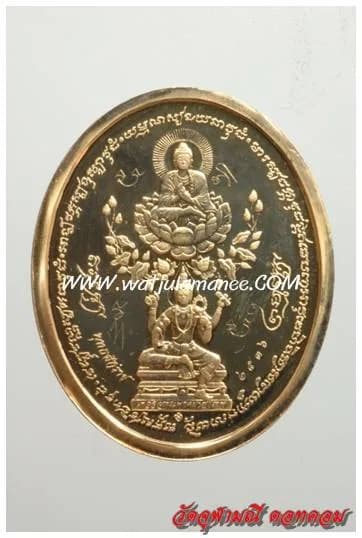
The Phra Nuea Phrom medal, stamped by the Royal Thai Mint of the Treasury Department, created in B.E. 2536 and brought into a grand consecration rite at Wat Chulamanee on 4 March B.E. 2538, empowered by over 80 revered monk-masters — uniting the Buddha, Maha Phrom Thada, and Tao Wessuwan within a single medal.
The Phra Nuea Phrom medal of Wat Chulamanee, Samut Songkhram Province, is a medal that gathers profoundly auspicious meanings into a single piece — the Buddha, Maha Phrom Thada, Tao Wessuwan Phrommasutithep, and Tao Wessuwanno of the Four Heavenly Kings all together. The medal was stamped by the Royal Thai Mint of the Treasury Department, created in the Buddhist year B.E. 2536 (1993 CE), and brought into a grand Buddhābhiseka consecration rite at Wat Chulamanee on 4 March B.E. 2538 (1995 CE).
Origin and Creation
This edition was brought into a grand Buddhābhiseka consecration rite at Wat Chulamanee, with more than 80 revered monk-masters joining in the empowerment. It was made in four materials, namely:
Gold material
Silver material
Alpaca material
Aluminium bronze (brass) material
The Sacred Features of the Medal
On the front of the medal, the upper part bears Maha Phrom Thada, the creator who ordains the course of all things; the lower part bears Tao Wessuwanno of the Four Heavenly Kings, the deity of treasure hoards, the great god of riches and abundance, the guardian of the wealth of the heavenly realms. The whole medal is encircled by a sacred chant.
On the back of the medal, the design conveys the exalting of the Lord Buddha, the Fully Self-Enlightened One, above all things in the world, with Tao Wessuwan Phrommasutithep — who is of the Brahma realm — placed below, signifying the guarding and protection of Buddhism. This is the origin of the name "Phra Nuea Phrom" (the Buddha Above Brahma).
The Chant Around the Medal
The sacred chant encircling the medal
โองการพินทุนาถัง อุปปันนัง พรหมาสะหะปะฏินามะ อาทิกัปเป สุอาคะโต ปัจจะปะถุมัง ทิสสะวา นะโมพุทธายะวันทะนัง
สิทธิกิจจัง สิทธิกัมมัง สิทธิการิยะ ตะถาคะโต สิทธิเตโช ชะโยนิจจัง สิทธิลาโภ นิรันตะรัง สัพพะกัมมัง ประสิทธิเม สัพพะสิทธิ ภะวันตุเต
The overall meaning is that whatever one undertakes succeeds in every way, fortune and gain arise, and all misfortune and ill omen are driven away.
Phra Phrom — the Creator, the Ordainer of Destiny
The figure enshrined in the upper part of the medal is Maha Phrom Thada, or Phra Phrom, the creator god who ordains the course of all things and who fixes the destiny of every human life. Phra Phrom therefore knows the movements of all living beings; the great events of the world all lie within his gaze. He is a mighty supreme deity, one of the three of the Trimurti, and he ever hearkens to the prayers of the faithful. Those who venerate Phra Phrom and do good are granted blessings so that their wishes are fulfilled.
Phra Phrom bears many names, such as Phra Phromma, Phra Phrahma, Phra Phrom Thada, Tao Maha Phrom, Prajapati, Adikavi, Atmabhu, and Lokathipadi, among others.
The Birth of Phra Phrom in the Various Traditions
The story of Phra Phrom's origin appears in many scriptures.
According to the Purāṇa scriptures of the Vaishnava tradition (which holds Vishnu supreme), it is said that Phra Phrom was born in a lotus that rose from the navel of Vishnu — meaning that Vishnu existed before all things, and when he wished to create the world he gave birth to Phra Phrom for this task.
According to the Purāṇa scriptures of the Shaiva tradition (which holds Shiva supreme), it is said that Shiva stroked one of his hands with the other until a light arose, and Phra Phrom came forth from that light, for Shiva wished to create the world; this legend therefore holds that Shiva existed before all things.
As for the Purāṇa scriptures of the Brahma tradition itself, it is recorded that Phra Phrom arose of himself with nothing preceding him — that in truth he has no point of origin, existing from the very beginning of the universe. This state is called Apava. When he wished to create all things, he divided himself into two parts, one male and the other female (Saraswati), and together they created the deities, humans, animals, and all the plants of the world.
The Attributes and Veneration of Phra Phrom
Phra Phrom is the god of creation, possessing the power to ordain the destinies of lives by governing all things in accordance with the law of karma. He protects the good and punishes those who do evil; upon those whose hearts are generous and self-sacrificing for the common good, he bestows happiness and fullness in life. Devotees who chant in his veneration gain wisdom in their livelihood, are protected from enemies, and receive purity of spirit.
Phra Phrom delights in calm simplicity, is gentle of heart, and ever loves all the beings he has created. His veneration therefore favors simple, sincere intention rather than grand and noisy display. He taught his disciples to chant "สัก ชิต เอกัม พรหมมา" ("Sak Chit Ekam Phromma") or "โอม อาฮัม พรหมมา อัสมิ" ("Om Aham Phromma Asmi"), then to sit in meditation, fixing the mind upon him for as long as possible; for he taught that to sit still recalling him, to eat a vegetarian diet, and to cause no trouble to others is the finest way to repay his grace.
The Weapons of Phra Phrom
The principal weapons of Phra Phrom are four, each bearing a meaning in the Dhamma.
Prayer beads (rosary) — the reciting of prayers to radiate loving-kindness toward all living beings
Lotus — the beauty of the Dhamma and of goodness; he teaches humankind ever to do good and to be compassionate toward one another
Scripture — establishing oneself in goodness, studying the chants and yoga in order to press straight toward the Lord God
Water pot (kamandalu) — the kalasha vessel with which ascetics draw pure water from the Ganges for use in rites of deva-worship
Besides these four principal weapons, there are many other weapons according to whatever the artisans may imagine to enrich the meaning, such as a bow, spear, mirror, conch, sword, discus, mace, as well as various musical instruments.
The Four Faces Are the Four Vedas
Phra Phrom is the giver of the Vedic scriptures; his four faces therefore signify the four Vedas.
The eastern face is the Ṛgveda
The southern face is the Yajurveda
The western face is the Sāmaveda
The northern face is the Atharvaveda
Tao Wessuwan — the Great God of Wealth
The figure enshrined in the lower part of the medal is Tao Wessuwan, or Tao Kuvera, the god of treasure hoards, keeper of the wealth of the heavenly realms. He is commonly seen in the form of a yaksha standing and holding a long club, but in truth he also has icons in the form of a man seated in the maharaja-lila posture, with a protruding belly as his distinctive feature. It is said that those whose occupations involve death often carry an image of Tao Wessuwan around the neck as an amulet to guard against harm from malevolent spirits. The image of Tao Kuvera in the form of a pot-bellied man is revered as the god of riches, while the form of the yaksha is revered as an amulet to ward off ghosts and demons.
From the Thai Encyclopedia (Royal Institute edition), Volume 3
It speaks of Tao Kuvera, or Tao Wessuwan, as the lord of yakshas who is master of the treasure hoards, with yakshas and guhyaka (yakshas who guard the treasure hoards) as his retinue. He is sometimes called Tao Vaisravana; in Tamil he is called Kuperan; in the Ramakian he is a half-brother of Thotsakan (Ravana). The city of Tao Kuvera is named Alaka, upon the Himalayas, and he is the Lokapāla of the northern quarter. The Chinese call him Tuo-wen or Tuo-bun, and the Japanese call him Bishamon.
Tao Kuvera dwells upon the summit of Mount Yugandhara, in the Isana capital. There is a great pond named Dharani, 50 yojanas wide, thick with lotuses and manifold kinds of water creatures. At the pond's edge stands a pavilion named Bhakalawadi, 12 yojanas wide, a place of rest and a club-hall for his yaksha retinue. He has 32 yaksha commanders, 12 yakshas guarding the city, 12 yakshas guarding the gates of the palace, and a further 9 yakshas who are his servants. Some say Tao Wessuwan is green of body, 2 gavutas tall, bearing a club as his weapon, with elephants, horses, and chariots as his conveyances, wearing a crown adorned with the figure of a naga, holding the rank of lord of yakshas, with a vast and immense retinue.
Tao Wessuwan bears many names according to his attributes, such as Vaisravana, Vessuvana, Thanabodi (lord of wealth), Thanesuan (master of wealth), Ucchavasu (rich at will), Yaksharaja (king of yakshas), Rattanakhan (jeweled-belly), and Isasakhi (friend of Shiva), among others.
In the scripture of the Traiphum Phra Ruang, Tao Wessuwan is called "Tao Phaisop Maharaja," the lord of the hosts of yakshas and the deities of the northern quarter. The ornaments of his person and of his retinue are all of pure gold; his yaksha retinue bear golden hammers and golden pestles beyond counting, and he rides a horse of gold. This description shows that Tao Wessuwan is immensely rich, possessing gold beyond hundreds of millions.
On the Buddhist side, it appears in the Mahānidāna Sutta of the Dīgha Nikāya that the land where Tao Wessuwan resides is named Alakamanda, a city of the gods, beautiful and resplendent. This Tao Wessuwan, the deva-king and Lokapāla, is a noble being of the Sotāpanna (stream-enterer) stage. When Phra Maha Moggallana journeyed up to visit Indra at the Vejayanta great palace, Tao Wessuwan too came to join in the welcome.
In the commentary on the Lokapāla Sutta, it is said that on each uposatha day (the 8th and 15th of the waxing and waning moon), the Four Lokapāla always descend to inspect the human world. They carry golden tablets and pencils, going about to record the deeds of people everywhere; whoever makes merit and practices the Dhamma has their name written on the golden tablet and passed on to be offered to Indra, while whoever does evil has their name recorded and the account sent to Yama.
It is said in the Thewaphum (deva-realms) scripture that Tao Wessuwan cultivated the perfections for many thousands of years and received blessings from Ishvara and Phra Phrom to be the god of riches. Besides keeping the treasures, he also has the duty of watching over and protecting Buddhism, and of protecting those who sit in meditation practicing kammaṭṭhāna. The ancient scriptures therefore say that whoever hopes for advancement in fortune and rank, in wealth and money, and in power and destiny, should venerate the image of Tao Wessuwan.
Tao Wessuwan in Four Aspects
In traditional belief, Tao Wessuwan manifests in four aspects according to the planes of existence, as follows:
Tao Wessuwan Phrommasutithep — of the Brahma plane, golden in form, robed in gold
Tao Wessuwan Thepbutsutithep — of the Tāvatiṃsa plane, golden in form, robed in red
Tao Wessuwan of the Four Heavenly Kings — green or black in form, robed in green
Tao Wessuwan of the human plane — appearing in human form
The Chant for Venerating Tao Wessuwan
The chant for venerating Tao Wessuwan
Light 9 sticks of incense and 9 red roses, recite the Namo three times, and call to mind the Buddha, the Dhamma, the Sangha, your mother and father, and your teachers.
ปุตตะกาโม ละเภปุตตัง ธะนะกาโม ละเภธะนัง อัตถิกาเย กายะญายะ เทวานัง ปิยะตัง สุตตะวา
อิติปิโส ภะคะวา ยมมะราชาโน ท้าวเวสสุวรรณโณ มะระณัง สุขัง อะหัง สุคะโต นะโมพุทธายะ
ท้าวเวสสุวรรณโณ จตุมหาราชาชิกา ยักขะพันตา ภัทภูริโต เวสสะ พุสะ พุทธัง อะระหัง พุทโธ ท้าวเวสสุวรรณโณ นะโมพุทธายะ
Photographs of the Various Materials
Gold
Silver
Nickel (alpaca)
Brass
The Names of the Revered Monk-Masters Who Joined the Consecration
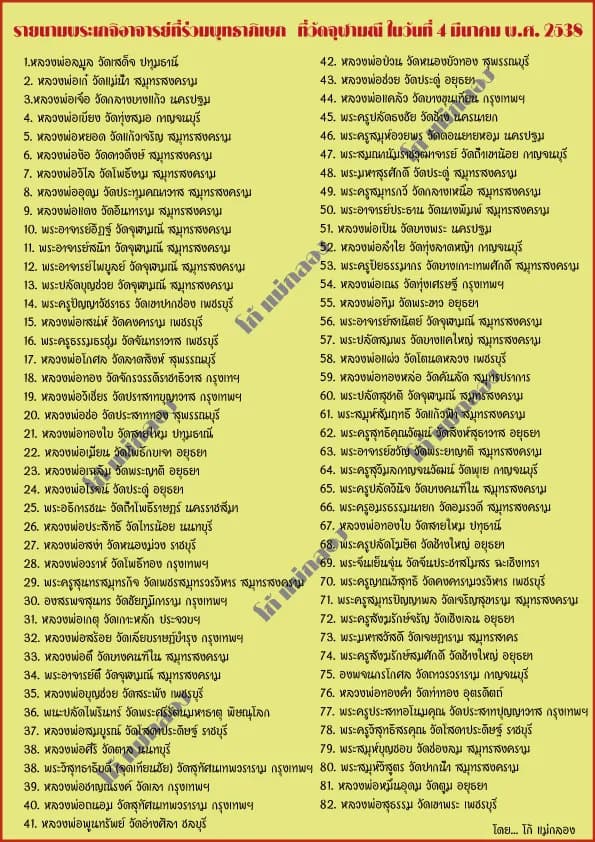
At the grand Buddhābhiseka consecration rite at Wat Chulamanee on 4 March B.E. 2538 (1995 CE), revered monk-masters from many provinces joined in sitting to empower and consecrate the medals — as many as 82 of them, as their names appear in the image.
Photographs of the Creation and the Companion Sacred Objects
Images documenting the record of the creation, the atmosphere of the Buddhābhiseka consecration rite, and other sacred objects created together in the same occasion, such as the Thewaratchabut votive powder image, the Na Nuea votive Buddha (phra kring), the Phra Pidta, and the Dilok yantra sticker.
Note: The section on history and legend was researched and compiled by Ko Maeklong, arranged together with an article recording the history of the medal's creation at Wat Chulamanee, in order to record the origin and the auspicious meaning of this edition. It is in no way intended for any purpose of buying or selling.