
A Fireside Chat — Why Phra Phuttha Chinnarat?
A fireside chat on why Phra Phuttha Chinnarat is the most-replicated Buddha image — from the time King Rama V had a copy cast for Wat Benchamabophit, to the reason Luang Pho Itthi chose to cast a replica of Phra Phuttha Chinnarat at Wat Chulamanee.
A Tale to Tell — A Fireside Chat on Why Phra Phuttha Chinnarat?
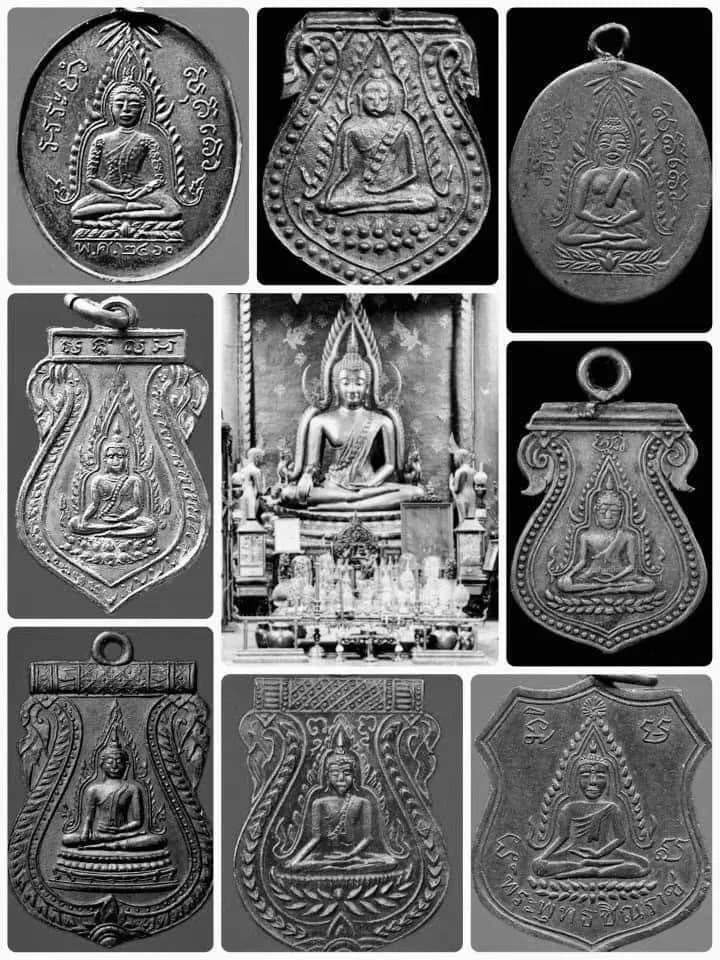
The Most-Replicated Buddha Image
One article states that Phra Phuttha Chinnarat is the most important Buddha image whose form has been copied and replicated the most. As we all commonly see, the principal Buddha images in ordination halls or viharas of various temples — both temples in Thailand and Thai temples abroad — are frequently Phra Phuttha Chinnarat. Even His Majesty King Chulalongkorn (King Rama V) graciously commanded Luang Prasit Patima (M.R. Mo Duangchak), the chief of the right-hand casting artisans and the finest casting craftsman, to go up and sculpt a model taken from the original Phra Phuttha Chinnarat, and He made the royal journey to take part in the ceremony of pouring the metal to cast Phra Phuttha Chinnarat piece by piece at the city of Phitsanulok on 20 October B.E. 2444 (1901). The cast pieces were then transported by boat to be assembled into the full image at the Naval Department, with Phraya Chonlayut Yothin (Andre du Plessis de Richelieu, a Dane who entered Thai naval service, holding the rank of Vice Admiral and the position of Commander of the Naval Department) supervising the finishing of the image. Once completed, it was borne aboard a pavilion barge in procession to be enshrined as the principal Buddha of the ordination hall of Wat Benchamabophit Dusitwanaram, and the celebratory ceremony was held on 13 December B.E. 2444 (1901).
When the Masters Chose Phra Phuttha Chinnarat
Beyond being replicated as principal Buddha images to be enshrined in various temples and monasteries, the image of Phra Phuttha Chinnarat has, in one past era, also been favored by many famous revered masters of old, who took its form to create small sacred objects such as medals or cast figures. These likewise gained popularity and command prices as high as the principal medal editions each master produced — for example, the Chinnarat medals of Luang Pu Suk of Wat Pak Khlong Makham Thao, Chai Nat province; Luang Pu Bun of Wat Klang Bang Kaeo, Nakhon Pathom province; Luang Pho Di of Wat Nuea, Kanchanaburi province; the Supreme Patriarch (Yu Yanothai) of Wat Saket, Phra Nakhon province; Pho Khui of Wat Ya Sai, Nonthaburi province; Luang Pho Chum of Wat Bang Na Nai, Samut Prakan province; the Chinnarat medal of Wat Lan Kha, Suphan Buri province; the Chinnarat medal of Wat Na Phra That, Nakhon Si Thammarat province; and that of Luang Pho Uam of Wat Sai, Samut Songkhram province, and so on.
Have we ever wondered why those potent, gnosis-endowed masters of old chose the form of Phra Phuttha Chinnarat to place upon their sacred objects? Why did they not create medals of the important Buddha images that resided at their own temples or in the provinces where they dwelt? I too wondered, and so I tried to gather information to seek the reason, until I came to read the royal writings of His Majesty King Mongkut (King Rama IV) and the chronicles of the era of Western colonial expansion. From these I could summarize the points (which are my personal opinion) briefly as follows.
From the Royal Writings of King Rama IV
From the royal writings of His Majesty King Mongkut (King Rama IV), it was written that Phra Phuttha Chinnarat was created by artisans of 4 schools — namely the Chiang Saen school, the Hariphunchai school, the Sawankhalok school, and the Si Satchanalai school — by the command of King Si Thammatraipidok, as one strategy in founding a new city (Phitsanulok). He wished for all 4 towns to jointly build viharas for the cardinal directions and to create 3 Buddha images to be enshrined in the viharas at the center of the new city, hoping thereby to foster harmony among them and to prevent malice or aggression toward one another in times to come — with the images of Phra Phuttha Chinnarat, Phra Phuttha Chinnasi, and Phra Si Sasada, jointly created, serving as anchors for the heart that would give rise to mutual love and harmony.
Moreover, Phra Phuttha Chinnarat was also an important Buddha image to which several past sovereign kings of the Ayutthaya kingdom had come to pay homage — such as King Ramesuan, King Maha Thammaracha, King Naresuan, King Ekathotsarot, King Borommakot, and others — for there was a belief that the merit of coming to venerate Phra Phuttha Chinnarat at the city of Phitsanulok made one a mighty king, victorious over all enemies. The subsequent kings of Siam then came to pay homage as a custom, extending down to the Rattanakosin period; King Phra Phutthayotfa Chulalok (King Rama I) had also come to pay homage to Phra Phuttha Chinnarat at the city of Phitsanulok when He held the rank of Chao Phraya Chakri.
Phra Phuttha Chinnarat in the Colonial Era
Then, in the reign of His Majesty King Vajiravudh (King Rama VI), that period was the era of Western colonial expansion, and so the country of Siam faced a problem regarding the security of its Thai identity. Thought was therefore mobilized to find some way to make the Western foreigners acknowledge Thai identity — that Siam too possessed a civilization on par with the West. "Phra Phuttha Chinnarat" was thus stirred into prominence in that era, and was raised up as a reference against the Western nations that were seeking a pretext to seize Siam as a colony — that the artistic beauty of Phra Phuttha Chinnarat reflected the highest advancement in the art and culture of the country of Siam, compelling the Western foreigners to acknowledge the civilization of the Thai nation. This was one reason that allowed Thailand to escape becoming a colony of the Western nations in that time.
By the great and mighty power of Phra Phuttha Chinnarat as described, together with the stirring up of the beauty of the Buddhist art of Phra Phuttha Chinnarat (during the colonial era of the years B.E. 2450–2470), the masters of old in that era favored creating Phra Phuttha Chinnarat medals to distribute to their disciples for protection and self-defense, bowing their minds in resolve to rely upon the Buddha-power of Phra Phuttha Chinnarat — believing that whoever kept a Phra Phuttha Chinnarat with them to venerate would bring about prosperity and flourishing, safe passage from harm, and would possess ascetic power and great authority as a mighty subduer, victorious over enemies and hosts of Mara.
Why Luang Pho Itthi Cast a Replica of Phra Phuttha Chinnarat
Personally, I think this too is likely one of the causal factors why Luang Pho Itthi chose to cast a replica of Phra Phuttha Chinnarat to serve as the principal Buddha of the multipurpose hall (Dome Pavilion) at Wat Chulamanee, Samut Songkhram province — hoping that his disciples would have mutual love and harmony and would not harbor malice toward one another, by the merit of jointly casting this great Phra Phuttha Chinnarat this time, and that once it is completed and accomplished, they will have the opportunity to come together to pay homage and ask for blessings with ease, without having to travel all the way to Phitsanulok province.
This evening's fireside chat has grown rather long, so I ask permission to bring it to a close here for now, and I hope that on the coming 23 July, I and all of us will have the opportunity to come together in the great merit-making of casting the great Phra Phuttha Chinnarat, together with our Luang Pho Itthi, to be enshrined as the principal Buddha of the multipurpose hall (Dome Pavilion) at Wat Chulamanee, Samut Songkhram province. Finally, may every one of you have good fortune, sleep well and dream sweetly. Good night.
Composed by
Khun Chang Bang Chak (Komsan Pisalsongkram) · 4 June B.E. 2563